Journal
Why Rolex? A Short History of an Obsession with Precision
WinThe.watch · 2026-08-12
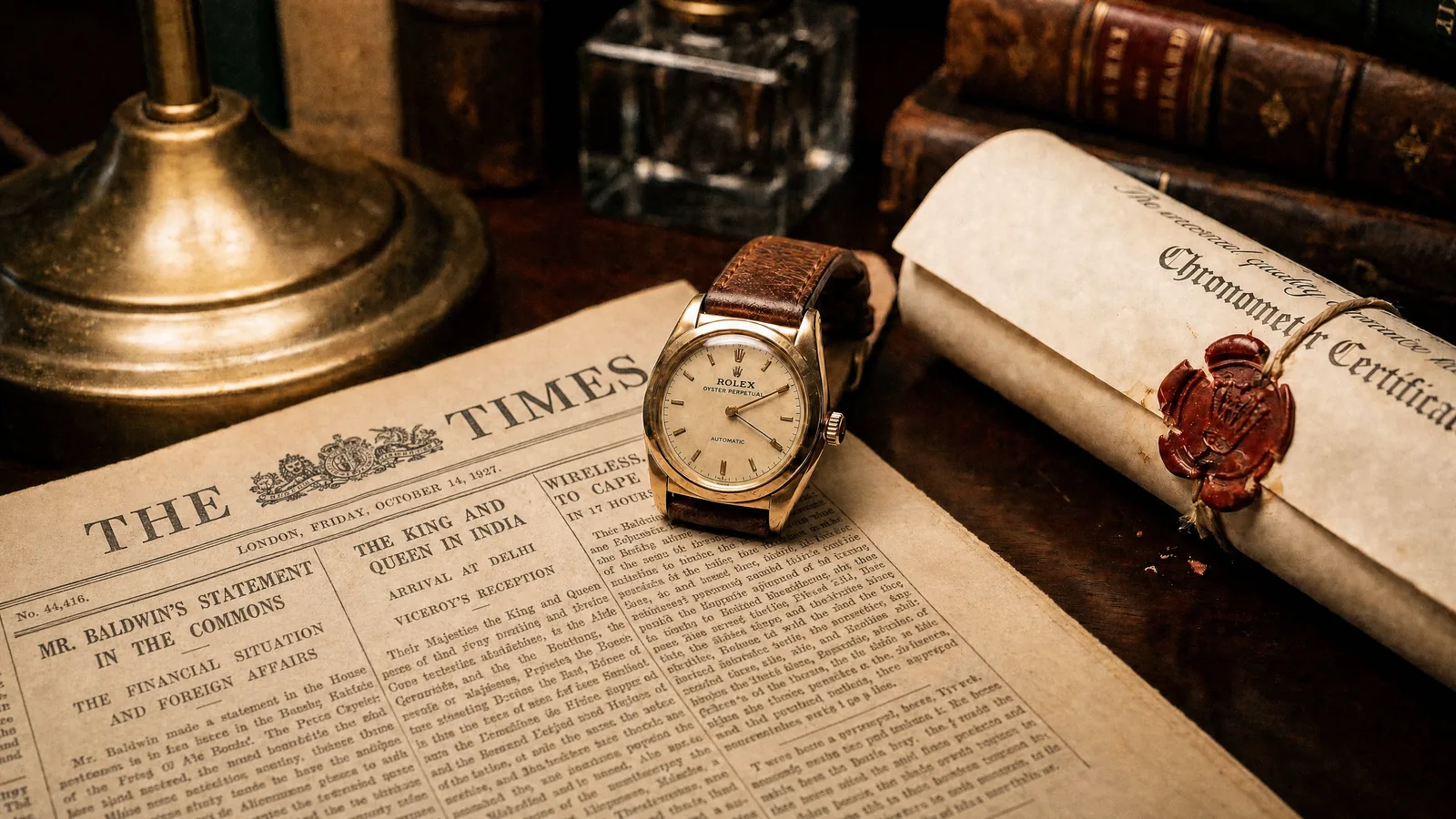
Ask why a Rolex costs what it costs and holds its value like almost nothing else you can wear, and the answer is not marketing alone. It is a century-long obsession with one idea: a wristwatch should be as precise as a scientific instrument. Here is how that idea prevailed.
1905: a 24-year-old with an unfashionable idea
When Hans Wilsdorf founded his company in London in 1905, serious men carried pocket watches. Wristwatches were dainty, fragile and famously inaccurate. Wilsdorf bet everything on the opposite: the future was on the wrist, and it would be won with precision. In 1908 he registered a short, invented name that could be said in any language — Rolex.
1910: the first certified wristwatch in history
In 1910 a Rolex became the first wristwatch ever to receive an official chronometer certificate, from the rating office in Bienne. Four years later, the Kew Observatory in Britain — the institution that certified marine chronometers for the Royal Navy — awarded a Rolex wristwatch a class A precision certificate. A watch worn on the arm had matched the instruments ships navigated by. The industry never quite recovered.
1926: the Oyster, and a swim across the Channel
Precision means nothing if dust and water get in. In 1926 Rolex launched the Oyster, the world’s first waterproof wristwatch case, sealed like its namesake. And then came the masterstroke: in 1927, when Mercedes Gleitze swam the English Channel, a Rolex Oyster travelled with her — and emerged running perfectly. Wilsdorf bought the front page of the Daily Mail to say so. The tool watch, and modern watch marketing, were born the same day.
1931 onwards: the machine that winds itself
In 1931 Rolex patented the Perpetual rotor, the self-winding mechanism that still powers the industry’s automatic watches. Then came the icons: the Datejust in 1945, the Submariner in 1953 — the same year a Rolex accompanied the Hillary and Norgay Everest expedition — the GMT-Master built for Pan Am pilots in 1955, the Day-Date in 1956. Each one solved a real problem for real professionals. That is why they became legends: they were tools first, trophies second.
Today: twice as precise as a chronometer needs to be
Every modern Rolex is a Superlative Chronometer: after passing the independent COSC chronometer test, each assembled watch is tested again in-house to a tolerance of —2/+2 seconds per day — more than twice as strict as the official standard. Case, movement, bracelet, even the gold alloys are made in-house. This vertically integrated approach supports the consistency of every watch, and helps explain the enduring demand and strong value retention that the brand enjoys.
Why this matters when a Rolex is the prize
When you enter one of our draws, this is what is actually on the table: not a logo, but a hundred years of engineering discipline in steel and gold. Learn to verify one yourself with our guide on how to tell if a Rolex is authentic, then see the live draws — or activate your free entry to this month’s Rolex draw.